http://www.newscientist.com/article/dn17198-turboevolution-shows-cod-speeding-to-extinction.html
Due to genetic selection by fisheries, cod have been evolving faster than expected. Fisheries catch cod near the surface making the cod which live in deeper waters have a much better chance of survival. PAN I is the gene which governs the depth in which the fish lives. As a result of this, cod with the A form of PAN I,living closer to the surface are caught, and this phenotype of PAN I seems to be dying out in the population.
Researchers have also found that cod are becoming mature more younger and this is seen as a result of selective pressure on the cod, by keeping more mature, ie bigger cod. In order to relieve such pressure on the cod, it is recommended to set aside arine reserves to increase the growth of the A form of PAN I, and place them back into the population again to slow down the evolution of cod.
by Chieh-yiu Cheng
Wednesday, June 3, 2009

Wednesday, April 29, 2009
Master Regulator Of Skin Formation

To many of us, our skin is one of the most important assets. Because the skin is a big deal, scientists spend plenty of time figuring out which factors cause skin disorders such as diseases or wrinkle formations with aging. So far it is concluded by scientists and other researchers that there is one gene discovered to be the affect of skin development. These genes are known as ‘CTIP2’ and its presence is vital. If there is an insufficient number of these genes or a lack of expression of these genes, the chances of experiencing skin disorders increase.
If the human body lacks the ‘CTIP2’ gene, the protective barrier (as displayed in the upper image) that surrounds the skin cells will not form at all. Without the barrier (shown in the lower image) the skin cannot develop to its highest potential which then consequently leaves the skin more vulnerable and defenceless against diseases and other aging factors such as wrinkle formation. The purpose is to allow maximum expression of these genes which then provides the cells with a barrier so that the cells can fight back against skin problems.
Scientists now have the knowledge to re-program cells in the sense that adult skin cells can be altered to stem cells. These stem cells have a higher hope of expressing these important genes than the normal skin cells will; although by no means is it guaranteed to work. Scientists are currently still discovering and upgrading methods that will take them one step closer every time to finding the most effective way of making these genes express very strongly.
http://www.sciencedaily.com/releases/2009/03/090324171608.htm
Fibrodysplasia ossificans progressiva

Researchers have associated a gene region, 4q27-31, on chromosome 4 to a severe disorder known as Fibrodysplasia ossificans progressiva (FOP). FOP is a rare disorder that is characterised by ongoing postnatal heterotopic ossification. Postnatal meaning after birth, heterotopic meaning abnormal anatomical conditions and ossification is defined as the transformation of soft tissue into bone tissue. When soft tissues are damaged they become ossified and this causes joints to be frozen permanently in place. There is no known cure for the debilitating disease. FOP is caused by spontaneous mutations in gametes and the allele has a high variability and complete penetrance. The spontaneous mutation causes injury sites to express an enzyme for bone repair in a malfunctioned state, hence there is excess bone morphogenetic protein 4 (BMP4).
Scientists were looking to identify the location of the gene. Researchers conducted an analysis of genomewide linkage by using four different families affected by the disorder. The PCR process was used to magnify the microsatellite markers that cover human autosomes. Genetic mapping was also used to determine the location of the gene. It was found that the FOP phenotype was linked to the 4q27-31 region on the 4th chromosome. This was associated with crossover events in meiosis and the researchers discovered that the FOP gene was within a 36cM between proximally by D4S1625 and distally by D4S2417. Within this interval it was determined that there was at least one gene involved in the bone morphogenetic protein-signalling pathways.
This study was important because the region where the active gene was located was discovered. By finding the region where the gene is active on the chromosome, scientists are able to do further studies into how to target the gene that affects the functions of the body. It may help scientists target and turn off the enzyme that creates BMP4 which is produced in bone repair.
JihHui Tseng - 42031451
http://www.pubmedcentral.nih.gov/articlerender.fcgi?tool=pubmed&pubmedid=10631143
Scientists Reveal Mechanism that Regulates Cancer-causing Genes.
Scientists have discovered how reactive oxygen species (a type of stress signal) regulate a cancer inducing protein. They believe this insight into protein dynamics within human cells could help with treating cancer through development of cancer-specific targeting drugs. Doctoral student D. Kemble and Prof. Gongqiu Sun of University of Rhode Island have provided a mechanism that describes how Src and Fibroblast Growth Factor Receptor protein families’ tyrosine kinases sense and respond to oxidation.
The Src enzyme has been previously recognised as a cancer-causing gene. It is a regulator of cell function, controlling the cell lifecycle including metabolism, division and death. Src is usually inactive unless undergoing the processes. If the Src regulator is disrupted, Src activity may become continuous turning the normal cell into a cancer cell. This disrupting factor is reactive oxygen species. Reactive oxygen species are by-products of oxygen-based metabolism and are produced during growth stimulation in cells, and they regulate other cellular processes. Accumulating data shows that reactive oxygen species can directly regulate the function of Src function and therefore indirectly control many cellular processes.
The URI researchers took a systematic approach, examined all the potential mechanisms and identified the Src sensor that responds to the ROS regulation. They also discovered this sensor was shared by several similar enzymes. According to Prof. Sun "Src function is under the control of several different mechanisms; each one needs to fit in with the others to form a seamless regulatory system."
Further study is underway into how these mechanisms work together to control Src function in cells.
Their results were published online March 9 in the Proceedings of the National Academy of Sciences.
Todd McLeish. “Mechanism That Regulates Cancer-Causing Gene, Revealed By URI Scientists.”
University of Rhode Island. Medical News Today. (28th March 2009)
http://www.medicalnewstoday.com/articles/144015.php
David J. Kemble and Gongqin Sun. Direct and specific inactivation of protein tyrosine kinases in the Src and FGFR families by reversible cysteine oxidation. Proceedings of the National Academy of Sciences. (9th March 2009)
http://www.pnas.org/content/early/2009/03/06/0806117106.abstract?sid=7d6cc3cf-fc2b-4be2-8045-1147af26e28c
Scientists have discovered how reactive oxygen species (a type of stress signal) regulate a cancer inducing protein. They believe this insight into protein dynamics within human cells could help with treating cancer through development of cancer-specific targeting drugs. Doctoral student D. Kemble and Prof. Gongqiu Sun of University of Rhode Island have provided a mechanism that describes how Src and Fibroblast Growth Factor Receptor protein families’ tyrosine kinases sense and respond to oxidation.
The Src enzyme has been previously recognised as a cancer-causing gene. It is a regulator of cell function, controlling the cell lifecycle including metabolism, division and death. Src is usually inactive unless undergoing the processes. If the Src regulator is disrupted, Src activity may become continuous turning the normal cell into a cancer cell. This disrupting factor is reactive oxygen species. Reactive oxygen species are by-products of oxygen-based metabolism and are produced during growth stimulation in cells, and they regulate other cellular processes. Accumulating data shows that reactive oxygen species can directly regulate the function of Src function and therefore indirectly control many cellular processes.
The URI researchers took a systematic approach, examined all the potential mechanisms and identified the Src sensor that responds to the ROS regulation. They also discovered this sensor was shared by several similar enzymes. According to Prof. Sun "Src function is under the control of several different mechanisms; each one needs to fit in with the others to form a seamless regulatory system."
Further study is underway into how these mechanisms work together to control Src function in cells.
Their results were published online March 9 in the Proceedings of the National Academy of Sciences.
Todd McLeish. “Mechanism That Regulates Cancer-Causing Gene, Revealed By URI Scientists.”
University of Rhode Island. Medical News Today. (28th March 2009)
http://www.medicalnewstoday.com/articles/144015.php
David J. Kemble and Gongqin Sun. Direct and specific inactivation of protein tyrosine kinases in the Src and FGFR families by reversible cysteine oxidation. Proceedings of the National Academy of Sciences. (9th March 2009)
http://www.pnas.org/content/early/2009/03/06/0806117106.abstract?sid=7d6cc3cf-fc2b-4be2-8045-1147af26e28c
Wednesday, April 8, 2009
New Virus-built Battery
Scientists from MIT have discovered a new type of battery made by genetically engineered viruses, which make both the positive and negative ends of lithium ion batteries. These batteries have the same power as most of the new batteries on the market at the moment and if perfected would be a major breakthrough more environmentally friendly power.
The battery works by using the common bacteria called bacteriophage (that can infect bacteria but not humans) these bacteria have been genetically modified to coat themselves with iron phosphate and grab hold of carbon nano tubes which are all connected to each other which in turn creates a highly conductive material.
The whole process is relatively easy. The process needs the environment to be below room temperature and also requires no harmful organic solvents. The materials used in the battery are also non-toxic. For the amount of power the battery can put out it is relatively light.
This is a very interesting topic as genetic engineering is really starting to take off in the world at the moment with new information being found all the time and to think that we can use viruses to specifically do what we want them to is incredible seeing as some viruses in the past have killed millions of people it’s incredible. The research is nowhere near perfected however it shows great potential as a new type of battery which could be a major factor in electric powered cars
The battery works by using the common bacteria called bacteriophage (that can infect bacteria but not humans) these bacteria have been genetically modified to coat themselves with iron phosphate and grab hold of carbon nano tubes which are all connected to each other which in turn creates a highly conductive material.
The whole process is relatively easy. The process needs the environment to be below room temperature and also requires no harmful organic solvents. The materials used in the battery are also non-toxic. For the amount of power the battery can put out it is relatively light.
This is a very interesting topic as genetic engineering is really starting to take off in the world at the moment with new information being found all the time and to think that we can use viruses to specifically do what we want them to is incredible seeing as some viruses in the past have killed millions of people it’s incredible. The research is nowhere near perfected however it shows great potential as a new type of battery which could be a major factor in electric powered cars

Reference: http://www.sciencedaily.com/releases/2009/04/090402143501.htm%20viewed%20on%205/4/09
http://www.cdrinfo.com/Sections/News/Details.aspx?NewsId=25133 viewed on 5/4/09
http://www.sciencemag.org/cgi/content/abstract/1171541v1 viewed on 5/4/09
http://sciencenow.sciencemag.org/cgi/content/full/sciencenow;2009/403/1 viewed on 5/4/09
written by cameron cotterell
Wednesday, April 1, 2009
Genome coding shedding light on the Dyslexia disorder

Geneticists from the National Human Genome Research Institute (NHGRI) in the United Kingdom, have recently shed light on the mysteries behind one of the world’s most prominent and current disorders; Dyslexia. Dyslexia (aka Dxeyilsa), being a brain disorder that often causes difficulty in reading and spelling, is suffered by at least 1 out of 10 Americans. It has been indisputably linked to heritage, and has long been thought to be caused by a mix of genetic and environmental factors.
Previous discoveries have been made, associating dxeyilsa with at least half a dozen gene variants, some of which are activated during the development of the brain. However, the specific method in which these variants disturb the brains normal patterns have remained unknown....until now.
On the 27th of March, 2009, the US/British team reported to have discovered a gene variant with the ability to reduce the production a protein connected to substantial brain development. "This work provides the first strong evidence demonstrating the effect of a functional variant involved in dyslexia," said NHGRI Scientific Director Eric D. Green, M.D., Ph.D., a co-senior author of the study. Researchers believe this could also be useful information to help track down the causes for other disorders and complex traits.
The study's lead author Megan Dennis believes that these results could one day be used to assist diagnosis and genetic screening for dyslexia
picture: Immunofluorescent image of KIAA0319 protein in cells. Credit: Antonio Velayos-Baeza, Ph.D., University of Oxford
By Shammai Davidson
Mutant Rats Resist Poison
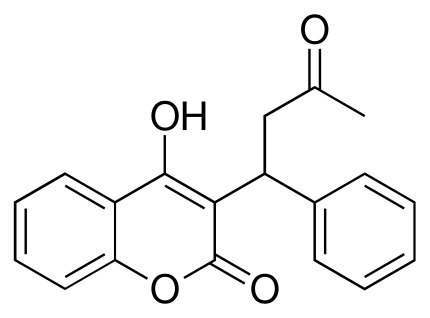
Around the world there have been discoveries of Rats with genetic mutations allowing them to have an immunity to rat poison. Eighteen new genetic changes have been found in rats from four different continents. The main rat poison that rats were claimed to have immunity from was Warfarin, but rats were also found to have immunity from other types of rat poison, because they work in the same way. Wararin and other rat poisons such as brodifacoum, are an anticoagulant, this means that they stop the blood from clotting. Rodents poisoned with anticoagulants die from internal bleeding, the result of loss of the bloods clotting ability and damage to the capillaries.
Wafarin and related toxins are extracted from the plant toxin Coumarin. Coumarin is found in many plants such as the tonka bean, vanilla grass, woodruff, and sweet grass, and is used in perfume, and more notably has medicinal value. They prevent blood coagulation by repressing the enzyme vitamin-K reductase (VKOR). Scientist carried out a study of VKORC1, the gene responsible for a key component of the VKOR multiprotein complex. ". Vitamin K epoxide reductase complex, subunit 1, also known as VKORC1, is a gene. Vitamin K is essential for blood clotting but must be enzymatically activated. This enzymatically activated form of vitamin K is a reduced form required for the carboxylation of glutamic acid residues in some blood-clotting proteins. According to the authors, "Mutations in VKORC1 may cause a heritable resistance to warfarin, possibly by preventing coumarin derivatives from interfering with the activity of the reductase enzyme".
Resistance against warfarin-like compounds has been reported in rodent populations from many countries around the world and poses a considerable problem for efficacy of pest control.
Article found online at:
http://esciencenews.com/articles/2009/02/06/mutant.rats.resist.warfarin
References:
http://www.qml.com.au/Files/Warfarin_030.pdf
http://animalscience.ucdavis.edu/Avian/pfs23.htm
http://esciencenews.com/articles/2009/02/17/mutant.rats.offer.clues.medical.mystery
Wafarin and related toxins are extracted from the plant toxin Coumarin. Coumarin is found in many plants such as the tonka bean, vanilla grass, woodruff, and sweet grass, and is used in perfume, and more notably has medicinal value. They prevent blood coagulation by repressing the enzyme vitamin-K reductase (VKOR). Scientist carried out a study of VKORC1, the gene responsible for a key component of the VKOR multiprotein complex. ". Vitamin K epoxide reductase complex, subunit 1, also known as VKORC1, is a gene. Vitamin K is essential for blood clotting but must be enzymatically activated. This enzymatically activated form of vitamin K is a reduced form required for the carboxylation of glutamic acid residues in some blood-clotting proteins. According to the authors, "Mutations in VKORC1 may cause a heritable resistance to warfarin, possibly by preventing coumarin derivatives from interfering with the activity of the reductase enzyme".
Resistance against warfarin-like compounds has been reported in rodent populations from many countries around the world and poses a considerable problem for efficacy of pest control.
Article found online at:
http://esciencenews.com/articles/2009/02/06/mutant.rats.resist.warfarin
References:
http://www.qml.com.au/Files/Warfarin_030.pdf
http://animalscience.ucdavis.edu/Avian/pfs23.htm
http://esciencenews.com/articles/2009/02/17/mutant.rats.offer.clues.medical.mystery
Subscribe to:
Comments (Atom)